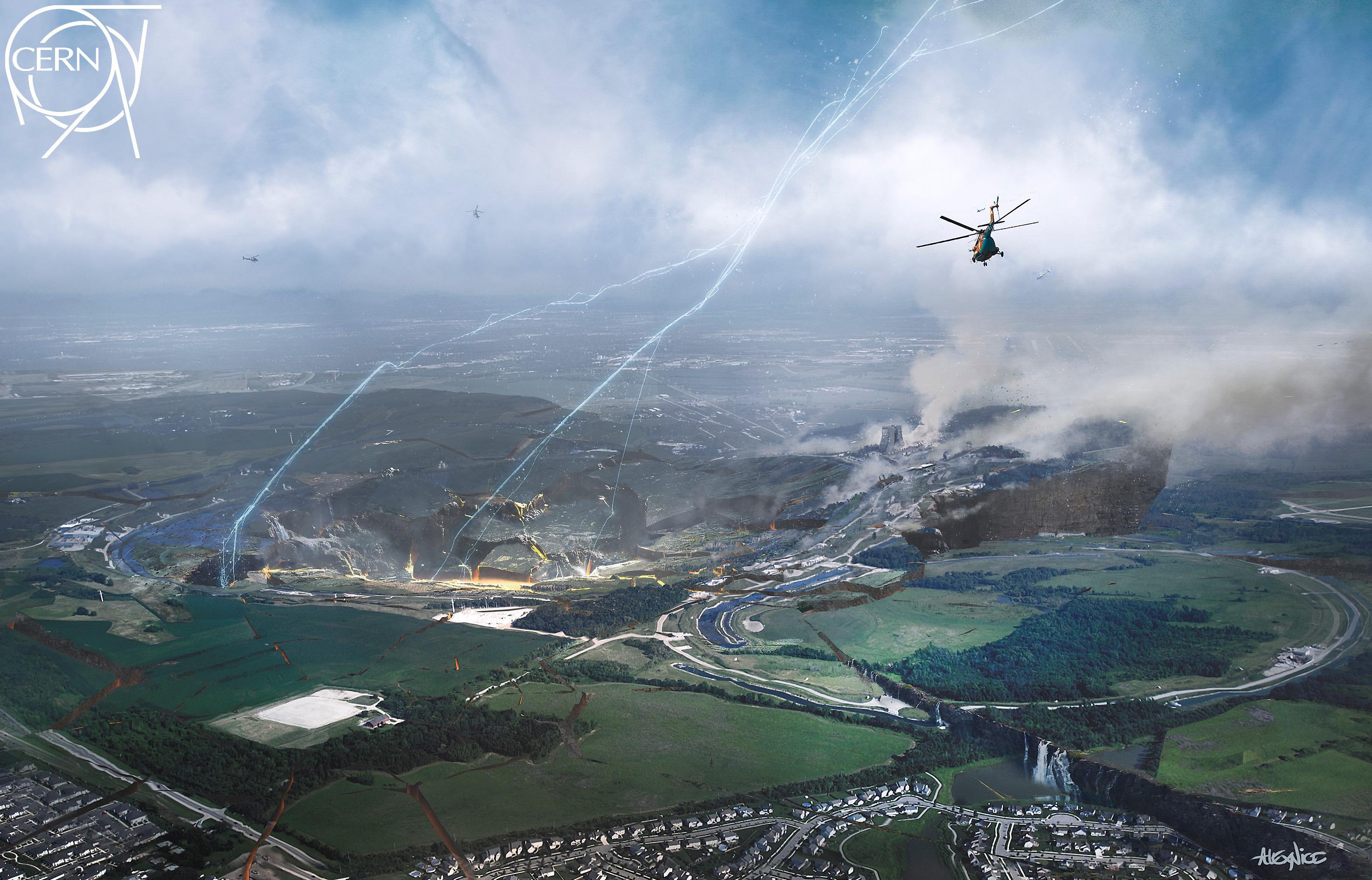
IMHO, I think it's awesome. It reminds me of one of the watercolor illustrations you'd find in a middle school text book or as a massive painting hanging in the lobby of the new headquarters after the "incident." Great work and a perfect fit for this sub.


I recently saw a live on TikTok talking about a recent article about the LHC on how it might cause the apocalypse and the person hosting the live straight up said "I don't understand any of this but.." and I moved on because anything they had to say was going to be some of the dumbest things I've ever heard.
People will really drive around in free moving engines powered by thousands of controlled explosions while thinking scientists playing around with particles dont know how to not destroy the universe.
This post was made by particle collider gang.
To be fair, some pretty prominent scientists and engineers weren't 100% sure the first nuclear tests wouldn't ignite the atmosphere.
They were pretty sure, but not completely.
As I understand it this is only partially true, and although it was a concern they ran the numbers a bunch and found it wasn't possible. They weren't actually willing to go forward if it was even slighty likely. Of course, you can't always be 100% sure of anything in life, and scientists tend to point that out a lot when declaring stuff.
For another example, you can mathematically prove that, within our physics modeling of the universe, that gravity won't turn off tomorrow. But can you prove it prove it? Not til tomorrow. However, despite this, you'd be hard pressed to find a scientist who would think gravity turning off is something to be worried about, despite an inability to prove it won't ahead of time with 100% certainty.
I mean... I'd hope they at least have some theories on the subject.
There is some reason why we see no other life in the universe. Maybe other species out there are black holing themselves? Probably not. Odds for war or climate destruction being the cause are much higher.
Advanced life might also be incredibly rare, like - one per galaxy or less, and there may be no way to cross between stars. It's impossible magic. The aliens are just too distant to detect. That's my guess.
Or they're keeping us as zoo animals / pets and we occasionally spot them on the radar, and then they just scoot away at Mach 20. That's also a likely scenario.
Yup. My bets are on distance and FTL travel actually being impossible.
I like the grabby aliens hypothesis.
Basically even at sublight speeds it would only take a few million years to colonize the galaxy. Any species that's likely to do so would inevitably alter the evolution on the planets they colonize as an unintentional byproduct of being there. Any species that wants to actually go through the trouble of sublight colonization would also be one that's expansionist and wants more territory, and would have done similar to what we've done on Earth to their homeworlds, colonizing everywhere habitable and generally being "grabby" about resources and land.
Because of this, no intelligent life is likely to emerge in the galaxy after colonization kicks off in earnest. So the only species likely to be smart enough to actually look at the sky and wonder if they're alone are likely to be this early set of species that evolves pre-colonization.
In other words, we don't see anyone else at this party because we got here early.
That's a more optimistic take at least. Better that we got here early than that countless species out there annihilated themselves in myriad ways. I like that option better, but am not certain I buy it.
It's not a silly question. There are plenty of unknowns. The LHC particle-collisions are millions of times as intense than anything going on inside your car engine. It's at least possible the scientists are on the wrong track about the details in there..
No there is literally zero chance that any particle collisions at the LHC will create anything close to a black hole. In order to create a black hole, enough mass would have to be compacted into an area small enough to create an event horizon (its Schwarzschild radius), and for something like a proton that would require compacting the proton's mass into a size so small that it would be far smaller than the Planck length, which according to the equations is literally the smallest measurable size. We are far far away from the energy required to do that. The LHC would need to be closer to the size of the entire solar system.
Unless M-theory is correct, in which case gravitational strings would be far stronger on a minute scale, and therefore capable of creating miniature black holes that disappear milliseconds after their creation.
The collisions aren't more intense than anything constantly happening in the upper atmosphere, so there's that
True, but they're not exactly the same as what's happening in the upper atmosphere. There's enough vagaries in the science that people can be anxious about it. If they did create a black hole or a neutron-object the size of a molecule, would it inevitably swallow the earth eventually? They say it's impossible, but I just don't know how much certainty they have on these things.
Black holes decay. And creating one the size of a molecule would take ungodly amounts of mass and energy.
The 'I don't know how much certainty they have on these things' should read 'I don't know much about these things.'
OK. They do supposedly slowly decay. They also swallow mass and matter.
Could you guarantee that they'd decay faster than they'd grow?
Your premise is that all this science is completely well-known and guaranteed harmless. Is there even a 0.1% chance there's more to it?
Didn't they just discover a 5th force of nature a couple years ago? That was unexpected. Maybe there are more unexpected details like that out there.
'supposedly' isn't 'supposedly' when we've literally observed it occurring. A black hole the size of a molecule, not exposed to mass, has nothing to consume (the lhc operates in a vacuum). Tertiary, you're completely ignoring the inability for us to even create these things due to the energy required.
I know that much-higher-energy events happen all the time in deep-space, and we get supercharged particle collisions from those events in the upper atmosphere. But then there are videos about 'quantum tunnelling' events in relation to cosmology, where very rare unexpected things can happen. It just seems like it's worth some attention.
But you've put me at ease. I can see that you have multiple PhD's so let me ask a couple related questions.
IF we did accidentally somehow make a micro-black-hole - in the vacuum chamber - how could we ever keep it in the center of the chamber? Are you supposing that we could manipulate such a thing with magnetic fields? Why wouldn't it instantly just fall into the earth and start swallowing matter? Please elaborate.
You've just thought up something with no knowledge of the subject, which is fine and good, but the problem is that you go on to assume nobody else has thought about it just because it's new to you. The people working at the LHC absolutely do have "multiple PhDs" and they have indeed thought about this. Instead of demanding satisfaction from a random Redditor, you could look that up.
Like, you mention quantum tunneling as an "unexpected" event. It's counterintuitive to laypeople, sure, but it's a very well-understood phenomenon that's not at all "unexpected" to physicists since at least the 60's if not earlier. It's part of undergrad physics curricula.
Basically, "quantum stuff is weird" doesn't mean "anything could happen." There are a lot bigger things to worry about, like how were demonstrably destroying the things we depend on to live though much more mundane means.
OK. Thanks for the link. You sure brought out the worst of you character, but thanks nonetheless.
I get that they say they can't be created by the LHC. I don't see anything in there that says we're safe if a tiny black hole did in fact find its way to earth. As far as I can tell, this says we'd be toast. Can you interpret all those equations? Give it a shot.
Thankfully I don't need to because they've already done the interpretation for you right there in the abstract. "A tiny black hole finding its way to Earth" is completely different than the LHC destroying the Earth, which is what the conversation was about, but they do address that. If it were a real concern, we'd see neutron stars and other dense objects getting eaten up by the same process. Which we don't.
If it's "the worst of my character" to point out that you're being presumptuous by assuming nobody's thought about this and demanding explanations from random Redditors, I think I'm doing okay. It's good to think about this stuff, really, just please have some humility about it instead of just angrily asserting things and challenging the internet to prove you wrong.
The less massive (and the much smaller) black holes are, the quicker they "evaporate" via Hawking radiation