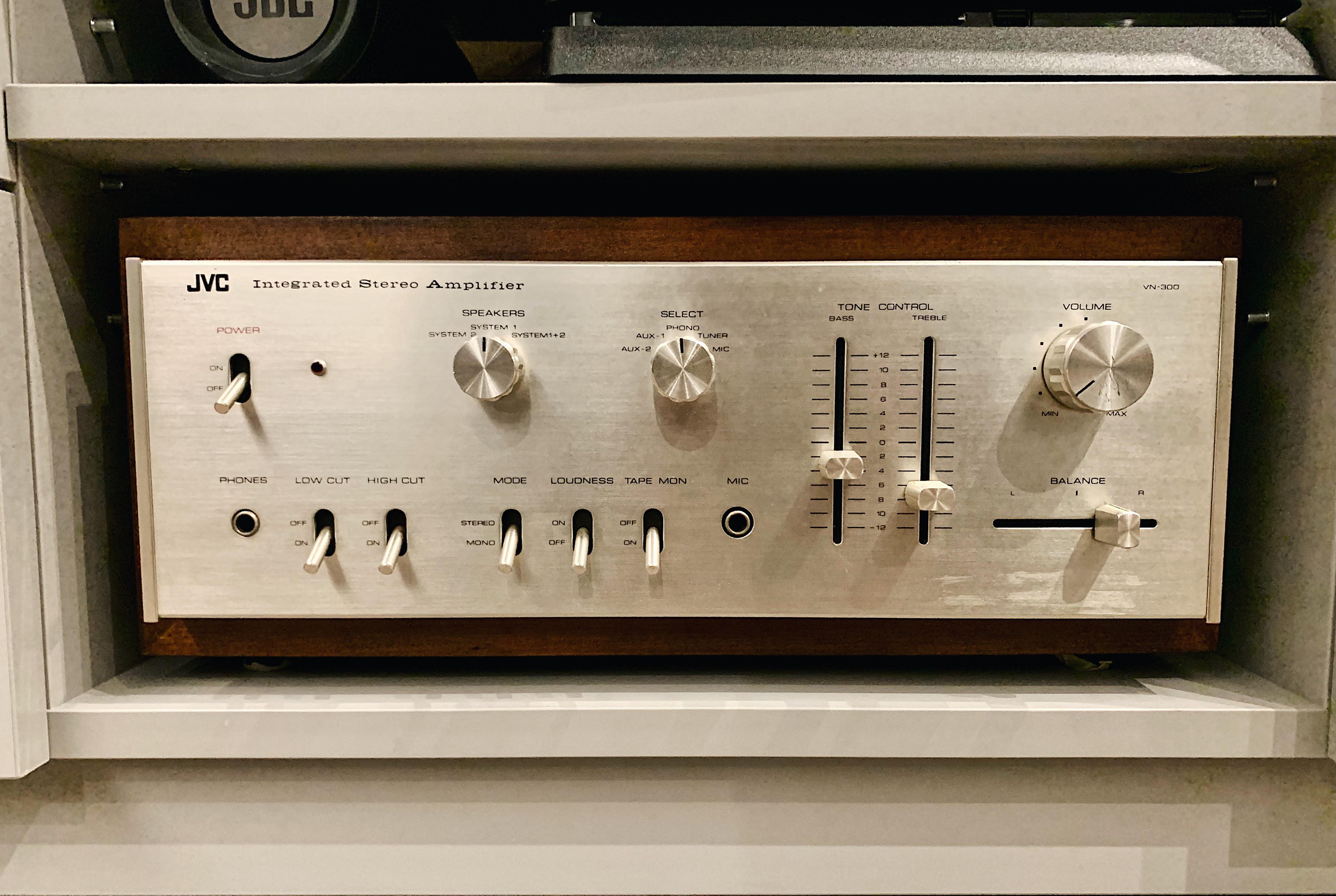
Back in the 1970s and 1980s, the AAFES stories (Army & Air Force Exchange Service) at most overseas bases would have dedicated stories with shelves full of these, all powered up and ready for testing. I forgot what those stores were called... Four Seasons maybe. Being overseas they'd also get a lot of oddball units from Kenwood, JVC, Sansui, Technics, etc that would become rare.
Unfortunately I was just a kid back then, but man those Four Seasons stereo outlets were an incredible place to be in. I'd go in there to load up on the free brochures. Average price of a stereo component was $300-500 back then, which is like $1500-2000 now, so that was some serious, serious money, kind of like graphics cards now.
This era of audio equipment will always be my favorite. The brushed-metal-on-wood look is beautiful, and the heavy knobs and solid switches feel high quality. These old amps were built like tanks and there's a good reason they're still so popular on the used market.
[deleted]
Bluetooth can be solved but surround sound I never could, or things like Dolby Atmos if you care. If you aren’t using it for your tv setup definitely no need to upgrade
For me stereo is enough, for I have only two ears.
I’m jealous, sadly I can still tell if a sound is not only to just the left or right but also in front of or behind me. It does make a huge difference for movies
I once worked with a guy who invented a technology that reproduced sound in a 3D arena with just 2 speakers. I may just have 2 ears, but it's amazing when the sound appears anywhere around you.
Coincidentally, I was just messing around with my main 7 (8 if I need the sub) speaker main system and 4 speaker satellite system. Overkill is fun.
That’s not… no.
Surround sound can be solved using an external digital decoder and multiple amps.
I don’t have room for anything other than one receiver and that seems to be getting a little ridiculous just to keep using an old receiver especially since it would cost more than just a new one right? Don’t get me wrong I love mine and moved it to my office and use it to listen to records
Well, that's the solution. If you have other requirements, then it might not work. To me, the difference between 1 and 2 old amps is far smaller than the difference between 0 and 1.
So I get it. While I've always kind of wanted to go and get another copy of my old Rotel, I've never been able to justify the cost and space. But if I were going that way, getting a smaller amp to run my surround sound and center channel, and then getting a powered subwoofer doesn't seem like that big of a stretch.
Yes but at that point it’s more nostalgia and less “buy it for life” as we are paying more to work around limitations than just replacing it.
So I think we agree these should be kept and used when possible it’s not a good example of this sub specifically
Honestly, I didn't even register what subreddit I was in until you pointed it out. Just a cool piece of equipment (even if impractical relative to what's replaced it in most scenarios).
Also it's not like new receivers aren't also "buy it for life", you just can't buy a $300 Denon and expect it to drive your crazy 1000w 7.4.2 surround system for 40 years
I hear you. I have an arc soundbar for my tv and a 2.1 channel unit for my record player.
I’ve done the 5.1 thing before for my tv system and it’s cool but it just wasn’t that good for the amount of effort to set up. And the way the arc can emulate placement is pretty impressive.
Agree! The fun (and geeky) part is that on/off knob's sound is a little bit different than any other knob!
More of a thunk as opposed to click?
Yeah, you got me! It's more of a thunk than a click for on/off switch
I miss that 70s-era thunk! component quality. And knobs where you had to put your whole wrist into the spin. Damn.
And I miss those specialized stereo stores that used to be around at that time. Looking at you, Audio Buys in Five Points Raleigh.
My dad had a similar amplifier growing up and I just loved the feel of all the switches and knobs. Such a cool piece of gear.
Mine did, too. Old school Pioneer amp that had a tuner knob that would just spin. It always felt really slick.
I miss 70's audio equipment. Marantz, Technics, Sansui, Yamaha... if I had tens of thousands of dollars to spare I'd buy all that great old stuff again.
I once found an old Sansui amp in the dumpster at my college, had a cracked circuit board. But it was easily repairable with a couple soldered jumpers. Anyway that thing CRANKED!!! With the right low end drivers I could shake the entire buildings shingles loose. Volume knob never went above 3. Needed earplugs at 4.
Yeah, it's fantastic, and they sound great. Most of the technological improvements since then haven't been about the actual sound.
I'm really confused. Obviously sound quality has improved by leaps and bounds in fifty years. Are you suggesting that this improvement is merely due to speaker technology rather than amplifiers? Because from a logical standpoint, what you are saying makes zero sense.
It actually makes a lot of sense. For amplifying an analog signal, we pretty much figured that out by 1970. The 2 main things you want in an amplifier are (1) low-to-non-existent distortion and (2) make things loud. High-end circuit designs from fifty years ago are perfectly able to accomplish this.
For speakers, yeah, a traditional dynamic speaker from decades ago probably won't sound that great compared to a newer one because speakers have moving parts and this causes them to have a limited lifetime. But the design of speakers also hasn't really changed that much. We have new and better materials that we can build them out of that increase their lifespan, but as far as reproducing tones that humans can actually hear (~20hz-20khz), we also pretty much figured that one out a long time ago. Different technologies for speakers definitely can make a difference (electrostatic, planar, etc.) but those technologies are not very common.
I would honestly argue the main improvements to sound quality have come in the form of the actual medium that music is available on, from 12ips tape to SACD to lossless digital audio, we've continued to come up with better and better ways of maintaining fidelity, s/n ratio, durability, etc.
It's really all about the signal you're feeding your amp and your speakers. If you have a great amp, whether it's built in 1970 or 2020, you will be able to get a great sound from your stereo without really being able to tell the age of the amp.
I'll add that audio engineering techniques on the production side have greatly increased improving the end product; but when it comes to the equipment vintage mics and preamps and speakers from the 60s on up still compete with any modern stuff even in the studio environment. Film to digital would be a good comparison, all the resolution - color - dynamic range been there for a minute.
Yes I agree. I originally wrote that a lot of guitarists still prefer to use amp designs from the 50s and 60s too, but I removed it before posting.
I'd agree, and share an anecdotal.
On my second pair of replacement Cerwin Vega speakers (dad bought in the early 80s). The first pair they had replaced the rubber/foam with something a little more synthetic(EDM maybe?). The latest pair the cone is now composite, foam appears to be the same. I haven't noted a difference in sound quality, I really only think that the foam is an enhancement in technology(originals we're pretty much dust when replaced), the rest is to make them cheaper to produce.
Just to add to the other responses: it turns out that most of the improvements in the last few decades, in terms of playback (amplification + speakers), have been on things like:
There have been marginal improvements in things like tweeter design, but for the most part the core sound quality has been a solved problem: for the frequencies that people can hear, played at reasonable volumes (compared to the size of the system), amplifying an audio signal is pretty close to measurably perfect, as most of the components are driven in the linear (distortion-free) regime.
As u/KarmicFedex and u/Bonefsh64 have wonderfully explained, high quality analog stuff for both recording and playback still sounds really fantastic (See how expensive high-quality vintage microphones are.); most apparent improvements have been in the inner part of the signal chain. For example, when CDs came out, a trained ear could hear the limitations of the tape they used to master recordings.
That, and that you can now get passably good sound out of a wireless, battery-powered speaker-amplifier the size of your forearm instead of requiring a system with an amplifier driving two standing speakers, each roughly the size of a toddler.
This one goes to 11
Not much of an audio guy but always loved this look too. I know they sound great as well. Do amps like this use considerably more power than modern equivalents?
The feel of working these old receivers is really enjoyable as well. The weight and precision of the machining on knobs, the mechanical action - clicks of a dial and the firmness buttons. Really adds a little extra joy to the ritual of playing some music.